
August 2026 Real Estate Market Report: Is the GTA Market Quietly Starting to Change?

August 2026 Real Estate Market Report: Is the GTA Market Quietly Starting to Change?
Toronto, Oakville and Burlington Market Update
Buyers wanted lower home prices. They got them.
They wanted relief from higher mortgage rates. Financing conditions have improved considerably from the peak.
And buyers now have something they haven't enjoyed for much of the past decade: time, selection and negotiating power.
Yet they still aren't rushing back into the housing market.
That makes August 2026 particularly interesting.
At first glance, it looked like another soft month for GTA real estate. Prices remained below last year's levels, sales slowed from July, and homes continued to take longer to sell.
But underneath those headlines, something important happened:
Housing inventory declined year-over-year in Toronto, Oakville and Burlington.
That doesn't mean the market has turned. It certainly doesn't mean another housing boom is around the corner.
But it may be one of the first signals worth watching as we head into the fall market.
August Is Usually a Slower Real Estate Month
Before interpreting the numbers, August needs some context.
August is traditionally one of the quieter months of the real estate calendar. Families are travelling, buyers take vacations, and sellers who aren't under pressure to move often wait until September to list.
That seasonal slowdown showed up clearly when comparing August with July.
Sales declined approximately:
- 10.5% in Burlington
- 21.0% in Oakville
- 22.5% in Toronto
But month-over-month numbers don't tell the whole story.
For a better picture of the market's direction, it is useful to compare August 2026 with August 2025.
And that's where the story becomes much more interesting.
The Biggest August Story Isn't Prices. It's Inventory.
For much of the recent market correction, sellers have faced a basic problem:
There have been too many homes competing for too few buyers.
August provided some evidence that this imbalance may finally be starting to change.
Active listings compared with August 2025 declined approximately:
Burlington: -9.8%
Oakville: -12.3%
Toronto: -6.2%
In other words, all three markets entered the end of summer with fewer homes available for sale than they had one year earlier.
That doesn't suddenly make this a seller's market.
Oakville and Toronto still had more than five months of inventory, homes were taking roughly 40 days to sell, and the overwhelming majority of properties did not sell above asking.
Buyers still have considerable leverage.
But the direction of inventory matters.
If supply continues contracting while buyer demand eventually improves, the balance between buyers and sellers can change surprisingly quickly.
That's why September and October could tell us much more about the direction of the market than August alone.

Burlington Real Estate: More Resilient Than the Headline Suggests
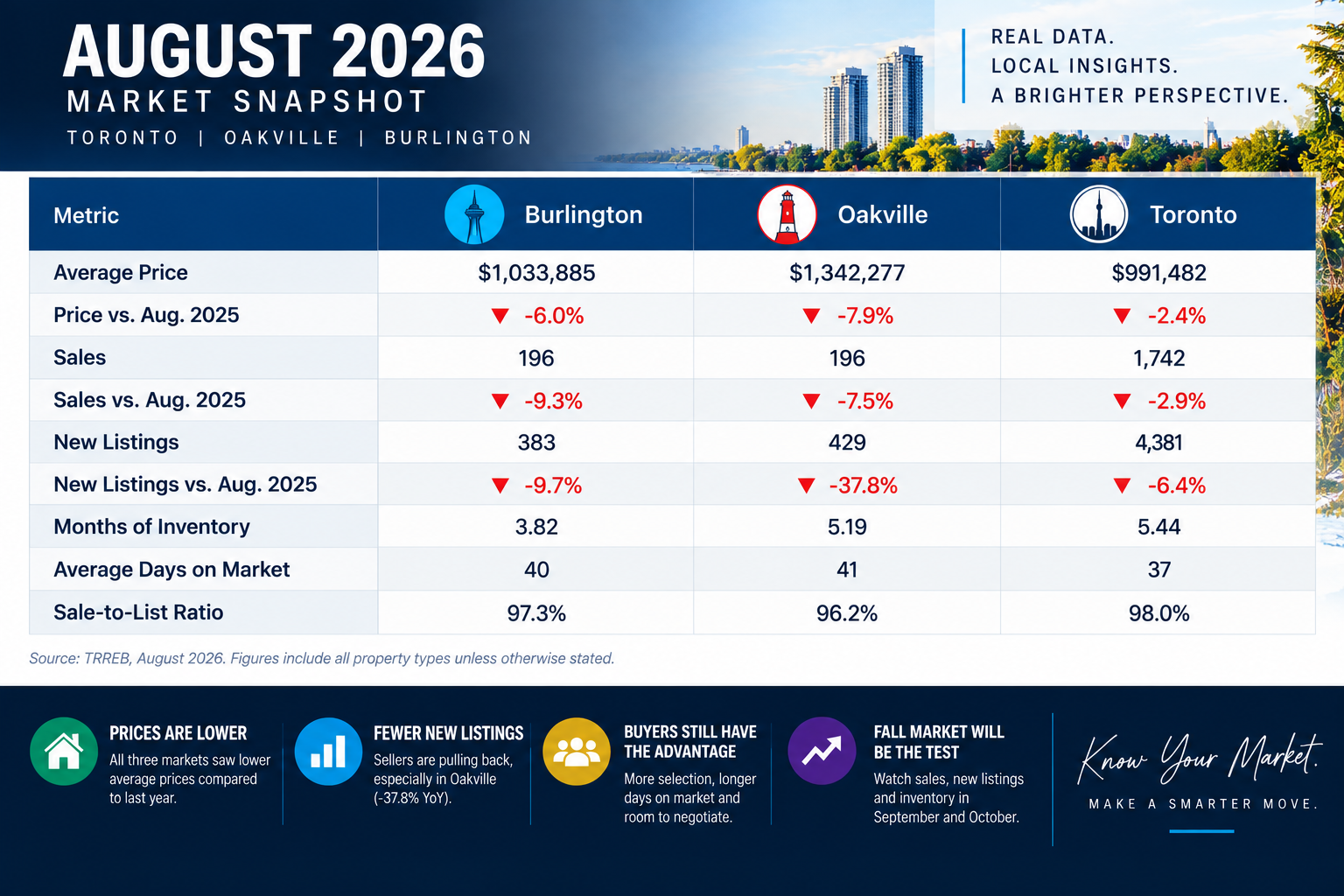
The average Burlington home sold for approximately $1.034 million in August, down 6.0% from August 2025 and essentially flat from July at -0.6%.
If you stopped there, you might conclude that Burlington housing values fell approximately 6%.
But averages can hide important differences between property types.
Burlington Detached Homes Tell a Different Story
The average detached Burlington home sold for approximately $1.416 million.
That was virtually unchanged from August 2025—up 0.1% year-over-year—and actually 5.5% higher than July.
That's a significant distinction.
The overall Burlington market weakened year-over-year, while detached housing showed considerably more resilience.
It is also why citywide averages should never be used by themselves to determine what an individual property gained or lost in value.
A detached home in Longmoor, Roseland or Shoreacres is not necessarily following the same market as a condominium near the GO station.
Burlington Buyers Still Have Negotiating Power
Burlington had approximately 3.82 months of inventory, considerably lower than Oakville or Toronto.
However, homes still took an average of 40 days to sell, compared with 38 days last August.
And only 14.3% of Burlington sales occurred above asking price.
For buyers, that means there is generally time to investigate a property properly, review comparable sales and negotiate rather than automatically competing.
For sellers, Burlington remains active—but buyers are highly price-sensitive.
A good house can sell.
An overpriced house can still sit.
Oakville Real Estate: Buyers Have Significant Leverage
Oakville was the softest of the three markets on price in August.
The average Oakville home sold for approximately $1.342 million, down 7.9% year-over-year and 4.2% from July.
Detached homes averaged approximately $1.783 million, down 6.5% from August 2025 and 6.0% from July.
Sales also slowed.
There were 196 transactions, down 7.5% from last August and 21% from July.
Homes took an average of 41 days to sell, while only 10.7% of Oakville sales occurred above asking price.
For a properly financed buyer, those numbers create opportunity.
But there is another Oakville number that may be even more important.

Oakville New Listings Fell Nearly 38%
There were only 429 new Oakville listings in August 2026.
One year earlier, there were 690.
That's a remarkable 37.8% year-over-year decline in new listings.
Even compared with July's 584 listings, new supply dropped 26.5%.
And this wasn't simply a shift caused by one property category.
Among detached homes specifically, new listings declined 32.3% year-over-year, from 319 to 216.
This raises an interesting possibility.
Buyers aren't rushing into Oakville—but sellers may also be becoming less willing to sell at today's prices unless they actually need to move.
Markets don't always stabilize because demand suddenly explodes.
Sometimes supply adjusts first.
Oakville still had approximately 5.19 months of inventory, so I would not characterize this as a tight market yet.
But the dramatic decline in new listings is something I will be watching closely this fall.
Toronto Real Estate: Still Soft, But Supply Is Moving in the Right Direction
Toronto provides useful context because Oakville and Burlington don't operate independently from the rest of the GTA.
Toronto's average home price was approximately $991,000, down 2.4% from August 2025 and only 0.7% from July.
Sales declined just 2.9% year-over-year.
New listings declined 6.4%.
And active listings were approximately 6.2% lower than last August.
Toronto still had 5.44 months of inventory, so buyers continue to have plenty of selection.
But once again, property type matters.
Toronto detached homes averaged approximately $1.538 million, down just 0.9% year-over-year and actually up 0.5% from July.
That is very different from some of the weakness we're seeing elsewhere, particularly in the condo segment.
Mortgage Rates Have Improved. So Why Aren't Buyers Coming Back?
This may be the biggest question facing Canadian housing.
Affordability has improved from the worst point of the cycle.
Mortgage rates have fallen substantially from where they were two years ago, although the improvement hasn't been equal across all mortgage products. Variable-rate borrowers benefited significantly as the Bank of Canada lowered its policy rate, while fixed mortgage rates remain heavily influenced by bond yields.
Canadian Mortgage Professional: Mortgage rates have dropped significantly
But lower borrowing costs alone haven't been enough to bring buyers flooding back.
Why?
Because buying a home isn't simply a mathematical decision.
It's also a confidence decision.
Buyers need confidence in their employment, their finances, the economy and, perhaps most importantly, that they aren't buying into a rapidly falling market.
RBC Expects a Recovery — But Not Another Boom
RBC's recent housing outlook provides an interesting framework for what could come next.
The bank expects Canadian housing activity to recover, but it doesn't anticipate a return to the extraordinary conditions experienced during the pandemic.
RBC estimates that hundreds of thousands of Canadians may have postponed major housing decisions—including buying, upsizing and downsizing—as affordability deteriorated.
Some of that delayed demand could eventually return.
However, RBC expects the recovery to vary considerably by region and housing type, with Toronto's condominium market potentially requiring more time to work through its challenges.
Real Estate Magazine: RBC says a housing recovery is coming, but don't expect a boom
That's an important distinction.
The next housing recovery doesn't necessarily require another enormous drop in mortgage rates.
It may simply require prices to become reasonable enough, monthly payments to become manageable enough and buyers to regain enough confidence to act.
What Could Happen in the Fall 2026 Real Estate Market?
September and October should provide a much clearer test of where this market is heading.
There are three numbers I will be watching closely: sales, new listings and active inventory.
Scenario 1: Sales Rise and Inventory Continues Falling
This would be the first meaningful sign that negotiating power could begin shifting.
More buyers competing for fewer available properties eventually puts pressure on prices—particularly for desirable detached homes in good neighbourhoods.
Scenario 2: Fall Listings Surge but Buyers Stay Cautious
Then sellers remain in a highly competitive environment.
Inventory could rebuild quickly, days on market could remain elevated and buyers would retain significant negotiating leverage.
Neither outcome is guaranteed.
That's why I'm not interested in declaring that we've reached "the bottom" based on one August report.
September and October have to prove it.
What August Means for Oakville and Burlington Buyers
For buyers, I still believe the advantage remains on your side of the table.
You have something that buyers rarely had during the pandemic market:
Time. Selection. Conditions. Negotiating power.
Most homes aren't selling above asking.
Oakville homes averaged 41 days on market. Burlington averaged 40.
And sellers whose homes have already been sitting for several weeks may be considerably more willing to negotiate than the asking price suggests.
That doesn't mean you should buy simply because prices have declined.
But trying to perfectly time the bottom can create its own risk.
When the right property appears, today's market gives buyers an opportunity to negotiate not only price, but potentially inspections, closing dates and other terms that were difficult to obtain during highly competitive markets.
Use that leverage while you have it.
What August Means for Sellers
Sellers should take a very different lesson from the decline in inventory.
Lower inventory does not mean you can suddenly overprice your home.
Buyers remain extremely disciplined.
Burlington homes sold for an average of approximately 97.3% of asking price.
Oakville averaged approximately 96.2%.
And homes in both cities were taking around 40 days to sell.
Pricing significantly above the market to "leave room for negotiation" can backfire.
The property sits.
Then comes the price reduction.
Buyers begin wondering why nobody bought it.
And suddenly the seller is negotiating from a weaker position.
Nearly 200 properties still sold in Burlington during August, and another 196 sold in Oakville.
Buyers exist. They're simply selective.
You don't necessarily need to be the cheapest home in your neighbourhood.
You need to make sense to today's buyer.
The Bottom Line: August May Have Changed the Question
The biggest takeaway from August isn't that prices fell again.
We already knew this was a softer housing market.
What deserves attention is supply.
Active inventory is lower than it was last August in Toronto, Oakville and Burlington.
Oakville experienced an extraordinary 38% decline in new listings.
Detached housing in Burlington and Toronto also proved considerably more resilient than their overall citywide price numbers suggest.
Buyers still have leverage.
Sellers still need to price carefully.
But that leverage isn't guaranteed forever.
The real question heading into fall is no longer simply:
"How much further will prices fall?"
It may increasingly become:
"What happens if buyers start coming back while fewer owners are willing to sell?"
September and October should start giving us that answer.
If you're considering buying or selling in Oakville or Burlington in the next 60 days or six months, the citywide numbers are only the starting point. Your neighbourhood, property type, price range and competition matter far more when making an actual decision.
The stats tell one side of the story—the strategy is the other. Reach out to discuss how this applies to your situation.

Roshan Basnet is a Real Estate Broker specializing in Oakville and Burlington. He helps buyers and sellers understand the local market, evaluate their options, and make smarter real estate decisions.
Thinking about buying or selling? Reach out to Roshan for a conversation about your plans and what today's market means for you.
Categories
Recent Posts



Work with me and “Keep What’s Yours! ®” a proven business model that saves home buyers and sellers thousands in real estate commissions.
4145 North Service Rd Unit: Q 2nd Floor L7L 6A3, Burlington, ON, Canada